VARIAN VACUUM TECHNOLOGIES 9530001 Torr Seal High Epoxy Kit Sealant
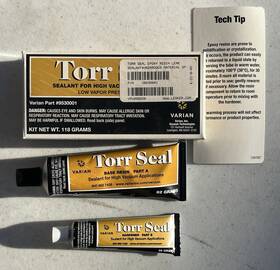
( Brand: Varian Vacuum Technologies ), ( Manufacturer Part Number: 9530001 ), ( Type: High Vacuum Epoxy Sealant ), ( Unit Type: Oz )
Review VARIAN VACUUM TECHNOLOGIES Torr Seal High Epoxy Sealant Kit New Factory Sealed
The **Varian Vacuum 9530001 Torr-Seal High-Epoxy Sealant Kit** is a premium, high-performance adhesive solution meticulously engineered for demanding vacuum applications where reliability, durability, and chemical resistance are paramount. Designed to create airtight, leak-proof seals in systems operating under extreme conditions including high-vacuum environments, cryogenic temperatures, and aggressive chemical exposures the kit delivers unmatched performance for critical industrial, scientific, and research applications. This two-part epoxy formulation combines exceptional adhesion properties with superior thermal and mechanical stability, ensuring long-term integrity even under cyclic thermal stress or repeated pressure fluctuations. The Torr-Seal epoxy is specifically formulated to bond seamlessly to a wide range of materials, including metals (such as stainless steel, aluminum, and copper), ceramics, glass, and certain plastics, making it an indispensable choice for sealing flanges, joints, and gaskets in vacuum chambers, mass spectrometers, semiconductor processing equipment, and high-energy physics apparatus. Its high purity and low outgassing characteristics minimize contamination risks, which is essential for maintaining ultra-high vacuum (UHV) levels in sensitive experiments or manufacturing processes. The kit includes precise application tools, ensuring ease of use while maximizing the sealant s effectiveness, and its long working life allows for meticulous alignment and curing under controlled conditions. Whether used in research laboratories, aerospace engineering, or advanced manufacturing, the Varian Torr-Seal High-Epoxy Sealant Kit stands as a trusted solution for professionals demanding nothing less than flawless performance in the most exacting vacuum environments.
The **Varian Vacuum 9530001 Torr Seal High Epoxy Sealant Kit** is a specialized product designed for creating high-vacuum seals in scientific, industrial, and laboratory applications. Below is a detailed breakdown of its pros and cons, followed by a conclusion and recommendation.
---
### **Pros**
1. **High Performance for Vacuum Applications**
The kit is specifically formulated to maintain excellent adhesion and sealing properties under high-vacuum conditions (down to ultra-high vacuum levels, depending on system requirements). This makes it ideal for applications such as vacuum chambers, cryogenic systems, and particle accelerators where outgassing and leak integrity are critical.
2. **Epoxy-Based Formulation**
Epoxy resins are known for their strong mechanical properties, chemical resistance, and thermal stability. This formulation ensures a durable bond that can withstand thermal cycling, vibration, and exposure to various gases or liquids without degrading easily.
3. **Versatility in Compatibility**
The kit is designed to bond a wide range of materials commonly used in vacuum systems, including metals (e.g., stainless steel, aluminum), ceramics, and certain plastics. This versatility simplifies integration into existing setups without requiring material-specific alternatives.
4. **Low Outgassing Characteristics**
Outgassing is a major concern in vacuum systems, as it can contaminate the environment and degrade vacuum quality. The high-quality epoxy in this kit is formulated to minimize outgassing, which is crucial for maintaining clean vacuum conditions over long periods.
5. **Easy Application and Curing**
The kit typically includes instructions for straightforward application, and the curing process is designed to be efficient (often within hours or days, depending on temperature). This reduces downtime compared to more complex sealing methods like welding or mechanical fittings.
6. **Long-Term Reliability**
When properly applied, epoxy seals can provide long-term reliability in vacuum systems, reducing the need for frequent maintenance or resealing. This is particularly valuable in research or industrial settings where system uptime is critical.
7. **Cost-Effective for Specialized Needs**
While not the cheapest sealing option, the kit offers a balance between performance and cost for applications where other methods (e.g., welding or specialized gaskets) may be impractical or more expensive.
---
### **Cons**
1. **Limited Flexibility**
Epoxy seals are rigid once cured, which means they may not accommodate thermal expansion or contraction as effectively as flexible materials like certain elastomers or metal gaskets. In systems with significant temperature fluctuations, this rigidity could lead to stress cracks or seal failure over time.
2. **Sensitivity to Surface Preparation**
The success of the seal heavily depends on proper surface preparation (e.g., cleaning, degreasing, and roughening). Improper preparation can result in weak adhesion, leaks, or premature failure. This requires additional time and precision during installation.
3. **Curing Time and Conditions**
The epoxy may require specific curing conditions (e.g., temperature, humidity) to achieve optimal performance. In environments where these conditions cannot be controlled (e.g., outdoor or high-humidity settings), the seal may not cure properly, leading to reduced effectiveness.
4. **Potential for Residual Stress**
During curing, epoxies can generate internal stress if not applied correctly. This stress can weaken the seal or cause it to crack, especially in thick applications or when bonding dissimilar materials with different coefficients of thermal expansion.
5. **Limited Repairability**
Once cured, epoxy seals are difficult to remove or repair without damaging the components they bond. This can be problematic if leaks occur after installation, as it may require disassembly or replacement of parts.
6. **Environmental and Safety Considerations**
Epoxy resins often contain volatile organic compounds (VOCs) or other chemicals that require proper ventilation during application. Handling and disposal of unused epoxy may also require adherence to specific safety protocols, adding complexity to the process.
7. **Not Ideal for Dynamic Seals**
This kit is designed for static seals (where components do not move relative to each other). For dynamic seals (e.g., rotating shafts or reciprocating parts), flexible materials like O-rings or metal bellows are typically more appropriate.
---
### **Conclusion**
The **Varian Vacuum 9530001 Torr Seal High Epoxy Sealant Kit** is a robust solution for applications requiring high-vacuum integrity, low outgassing, and strong mechanical bonding. Its epoxy-based formulation ensures durability and chemical resistance, making it suitable for demanding environments like research laboratories, semiconductor manufacturing, or particle physics experiments. However, its rigidity, sensitivity to surface preparation, and limited flexibility in thermal environments may pose challenges in certain applications. The kit is best suited for static, high-vacuum systems where long-term reliability and minimal contamination are priorities.
---
### **Recommendation**
**Use this kit if:**- You are working with a static vacuum system requiring ultra-high or high vacuum levels (e.g., below 10 -6 Torr).
- The components to be sealed are compatible with epoxy (e.g., metals, ceramics) and properly prepared.
- Your application does not involve significant thermal cycling or dynamic movement.
- You can control the curing environment (e.g., temperature, humidity) to ensure optimal adhesion.
- Cost and ease of application are secondary to performance and reliability.
**Avoid or consider alternatives if:**- Your system experiences extreme thermal fluctuations or requires flexible seals.
- The components cannot be properly cleaned or prepared for epoxy bonding.
- Dynamic sealing (e.g., rotating or reciprocating parts) is required opt for O-rings, metal gaskets, or bellows instead.
- You need a reusable or easily repairable seal mechanical fittings or welding may be better options.
- The application involves high humidity or outdoor conditions where epoxy curing may be unreliable.
For most **static, high-vacuum applications** where durability and cleanliness are critical, this kit is a strong choice. Pair it with proper surface preparation and curing procedures to maximize its effectiveness. If in doubt, consult Varian s technical documentation or a vacuum specialist to confirm compatibility with your specific system.
Details:
Ideal for laboratory, semiconductor, physics, and industrial vacuum applications. Model: TORR Seal. Lesser Company. Application: High / Ultra-High Vacuum.
Brand: Varian Vacuum Technologies. Chemical Type: Two-Part Epoxy.: High Vacuum Epoxy Sealant. Offered is a TORR Seal High Vacuum Epoxy Sealant Kit, manufactured by Varian Technologies, part number 9530001.
TORR Seal is widely used for sealing, bonding, and leak repair in high ultra-high vacuum systems, including chambers, flanges, fedoras, research instrumentation. MPN: 9530001. This is a brand new, factory-sealed kit complete with original packaging, Part A base resin, B hardener, and the Varian technical instruction card. Lesser distributor labeling, a well-known supplier to laboratory and ultra-high-vacuum environments.
Distributor Label: Kurt J. Condition: New. Packaging includes Kurt J. Packaging: Factory Sealed.
part #: 9530001 prices
- $125.00-$475.00
specifications sealantadhesivee:
- brand: Varian Vacuum Technologies
- mpn: 9530001
- type: High Vacuum Epoxy Sealant
- unit type: Oz
seller sealantadhesivee:
- rating: 98.0%
- city: Gainesville, Florida
- # reviews: 400
returns sealantadhesivee:
- policy: No Returns
offer sealantadhesivee:
- sold: 0
- best offers: True
- quantity: 1
- started: January 31, 2026
- availability: In Stock
- options: Ship-to-home
general sealantadhesivee:
- Adhesives, Sealants Tapes > Caulks, Sealants Removers > Caulks Sealants
- condition: New
payments sealantadhesivee:
- credit card: Mastercard
- wallet: Google-pay
- other
shipping sealantadhesivee:
- class: Standard
- type: Calculated
- carrier: USPS
- service: USPS Ground Advantage
- transit: 5-9 Days
- cost: $5.62